DEXA Scans vs. Smart Scales: Why Your Scale Is Probably Lying to You
Smart scales have gotten better. They're cheap, fast, and they live in your bathroom. But the technology behind them - bioelectrical impedance analysis, or BIA - hasn't changed much, and it has a fundamental problem: it estimates your body composition based on how fast an electrical current travels through your body, and that speed changes every time you eat, drink, sweat, or exercise. The number on the screen isn't measuring your fat. It's measuring your water, then guessing. A DEXA scan does something different. It uses low-dose X-rays to directly measure bone, lean mass, and fat - separately, by region, with a margin of error of roughly 1-2%. No guessing. No hydration variables. The same scan at 7am and 7pm gives you the same answer.
How Smart Scales Actually Work
Smart scale BIA sends a low-level electrical current through your body via the sensors on the scale plate. Fat resists the current; water conducts it. Based on that resistance reading - plus your height, weight, age, and sex - the scale estimates your body fat percentage.
The problem is the estimate. BIA doesn't measure fat directly. It measures total body water and works backward. That means anything that shifts your hydration also shifts your results:
- Drinking a large glass of water before stepping on drops your apparent body fat
- Being dehydrated raises it
- A workout in the last few hours redistributes fluid into your muscles and skews the reading
- Eating beforehand changes it
- Where you are in your menstrual cycle changes it
The Research Says:
A 2021 study published in the Journal of Medical Internet Research tested three commercially available smart scales against DEXA and found that smart scales are not accurate for body composition and should not replace DEXA scans. The variance wasn't small - for some individuals, the difference between their smart scale reading and their actual body fat percentage was large enough to change their entire health picture.
How DEXA Measures Body Composition
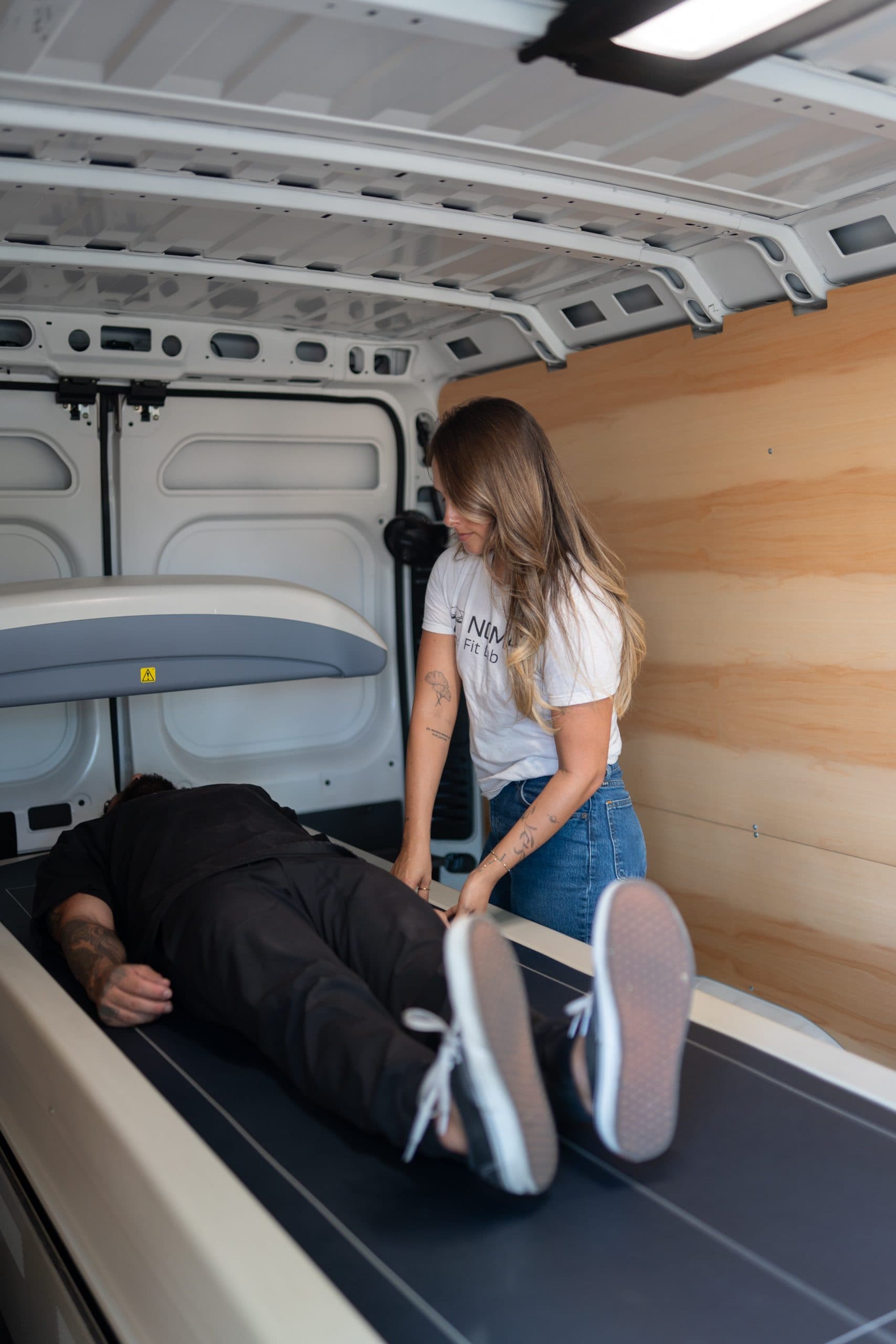
A DEXA scan uses two low-dose X-ray beams at different energy levels. Because bone, muscle, and fat absorb X-rays differently, the scanner can separate them precisely - not estimate them. The result is a full-body map showing:
- Total body fat percentage
- Lean muscle mass, broken down by region (arms, legs, trunk)
- Visceral fat (the fat around your organs that smart scales can't isolate)
- Bone mineral density
- Muscle imbalances between left and right sides
The Nomad Fit Lab Difference
The scan takes under 15 minutes. Nomad Fit Lab brings the scanner to your gym or neighborhood - no hospital or membership required. Results hit your inbox the same day.
DEXA vs. Smart Scales
| Feature | DEXA Scan | Smart Scale (BIA) |
|---|---|---|
| Method | Direct measurement via X-ray | Estimate based on resistance |
| Fat Mass Error | ~1-2% | 5-8%+ (varies with hydration) |
| Affected by hydration | No | Yes - significantly |
| Visceral fat | Measured directly | Estimated or unavailable |
| Bone density | Yes | No |
| Regional breakdown | Full-body map | None or limited |
| Results consistent day-to-day | Yes | No |
| Cost | From $39.95 | $30-$300 (device cost) |
When a Smart Scale is fine - and when it isn't
Smart scales aren't useless.
If you weigh yourself at the same time every morning under the same conditions and track the trend over months, a decent BIA scale can tell you directionally whether things are moving in the right direction.
Where they fail:
- Tracking muscle gain - BIA can't distinguish between fat loss and muscle gain at the same body weight. If you've been lifting for three months and your smart scale says nothing changed, it might be right about your weight and completely wrong about your composition.
- GLP-1 users tracking muscle loss - People on Ozempic, Wegovy, or Mounjaro are losing both fat and muscle during rapid weight loss. A smart scale won't show you that split. A DEXA scan will - which is exactly why retesting monthly for the first 3 months on GLP-1 medications is one of the most useful things you can do. Once a baseline weight is reached, check-in DEXA scans every 2-3 months is advisable.
- Anyone making a health decision based on a number - If your body fat reading is informing a conversation with a doctor, a trainer, or a nutritionist, you need a number you can trust. Smart scale readings can be off by 5-8 percentage points or more - enough to misclassify your health category entirely.
Everything You Need to Know
Is a smart scale accurate for body fat percentage?
Smart scales use bioelectrical impedance analysis (BIA) to estimate body fat, not measure it directly. Research shows they have a margin of error of 5-8% or more, and their readings can shift significantly based on hydration, meal timing, and exercise. For a general trend over time, they can be useful. For an accurate absolute number, they're not reliable.
Can a smart scale measure visceral fat?
Some smart scales claim to estimate visceral fat, but because BIA can't directly measure fat distribution - only total body water - those readings are calculated estimates based on population averages, not your actual anatomy. DEXA is the only widely available test that measures visceral fat directly.
How much more accurate is DEXA than a smart scale?
DEXA has a margin of error of approximately 1-2% for body fat percentage. Smart scales using BIA typically have a margin of error of 5-8%, and that number can be higher depending on conditions. For context: a 5% error on a reading of 25% body fat means your actual body fat could be anywhere from 20% to 30%.
Do smart scales measure bone density?
No. Smart scale BIA cannot measure bone mineral density. DEXA was originally developed for bone density assessment and remains the clinical standard for diagnosing osteopenia and osteoporosis.
How often should I get a DEXA scan instead of using a smart scale?
For most people who are not making major changes to diet or activity level, a DEXA scan every 3-6 months gives you reliable data to track meaningful changes. Smart scales can fill in the gaps between scans as a directional check - as long as you treat the body fat reading as approximate, not precise.
Get Numbers You Can Trust
Nomad Fit Lab is a mobile DEXA scan lab serving Western Washington and Greater Phoenix. We bring gold-standard body composition scans directly to your gym or neighborhood. The scan measures bone density, lean muscle mass by region, body fat percentage, visceral fat, and resting metabolic rate. From $39.95, under 15 minutes, with results in your inbox the same day.